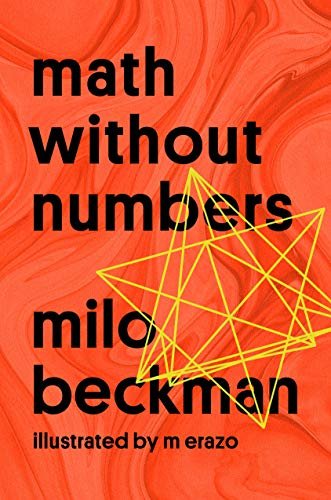
I’m not sure how much I like this book, some of it is really very good, but some is just not what I was interested in learning. - So lets approach this, by trying to work out what the aim is, and whether or not it is successful/fun in helping me understand something more about math. I note that a lot of people have struggled with the idea of math education, without scaring people off with the scary equations and scribbles in a different language. This is a delightful attempt to go the whole way and explain math without any of the numbers and equations - and whilst this automatically sets you up for failure, it is a nice stocking stuffer.
I think this book is really about the joy of the patterns of “pure” math (as opposed to applied math, not the elementary math you learn before 18), and why it is fun an interesting all on its own, - whether or not there are practical applications.
The problem is that it is a book about math without numbers, and so it is like a book about poetry with no poems. It’s very good, and has a lot of visual intuitive proofs. Illustrator m. erazo has done a wonderful job giveing the book a lightness and joy that matches the intent of the text. It does approach the idea of real world problems staring on p163, but this isn’t where the passion of the author is (although it is done well)
So who is the intended audience? (- well me - i.e. Christmas stocking stuffer for people who want to learn about math, from people who don’t want to learn about math) - Also people who like short books (2), that seem to say more than the text implies In fact most of the book is really written as a conversation with a friend - perhaps over a coffee, trying to explain to them about this math thing, with a bunch of napkins to scribble on. (Chatty as one reviewer put it) From that point of view it is an amazing success, and well worth trying out. Just don’t expect to be using any math in your life afterwards. I wouldn’t say it is essential reading, but it is fun and light. And if you know just a little bit of math like me, it might be very useful for all those tricky philosophical questions, like should I really believe this bit - what do mathematicians really think about that bit. I guess I’m saying that for me it isn’t a home run, but a double base hit. If you see a copy, give it a go and tell me what you think.